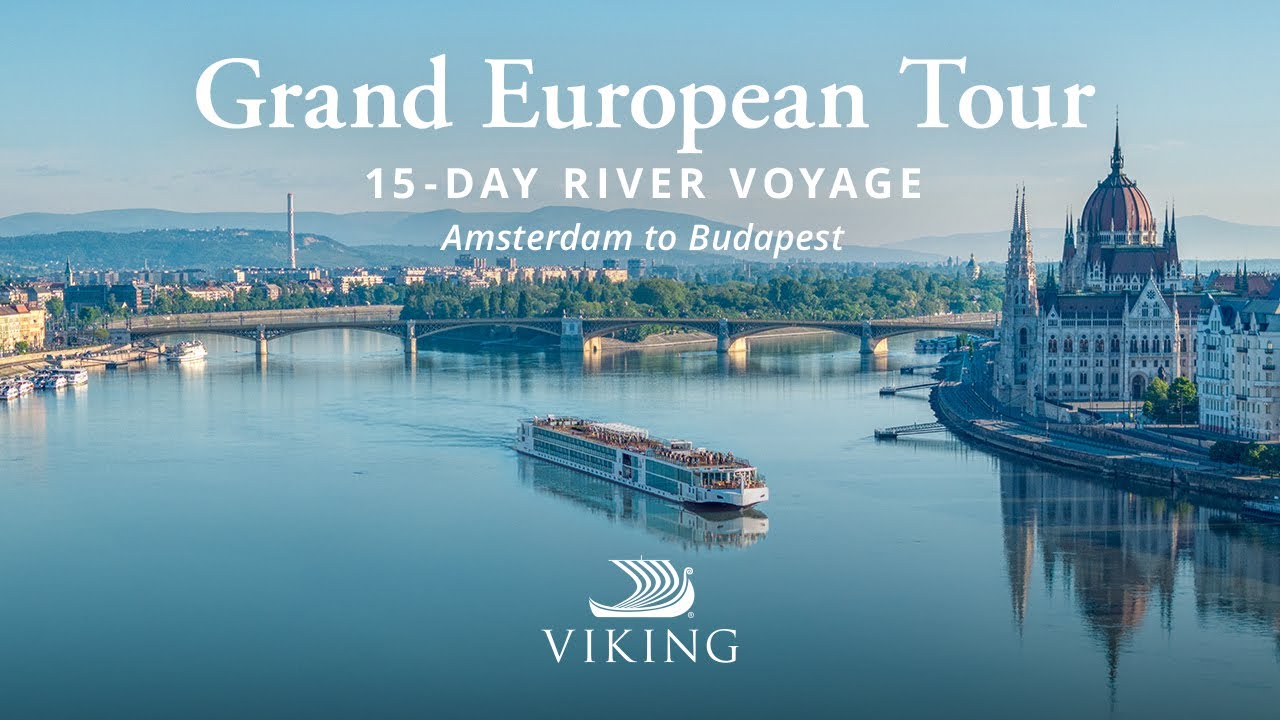
Travel through the heart of Europe
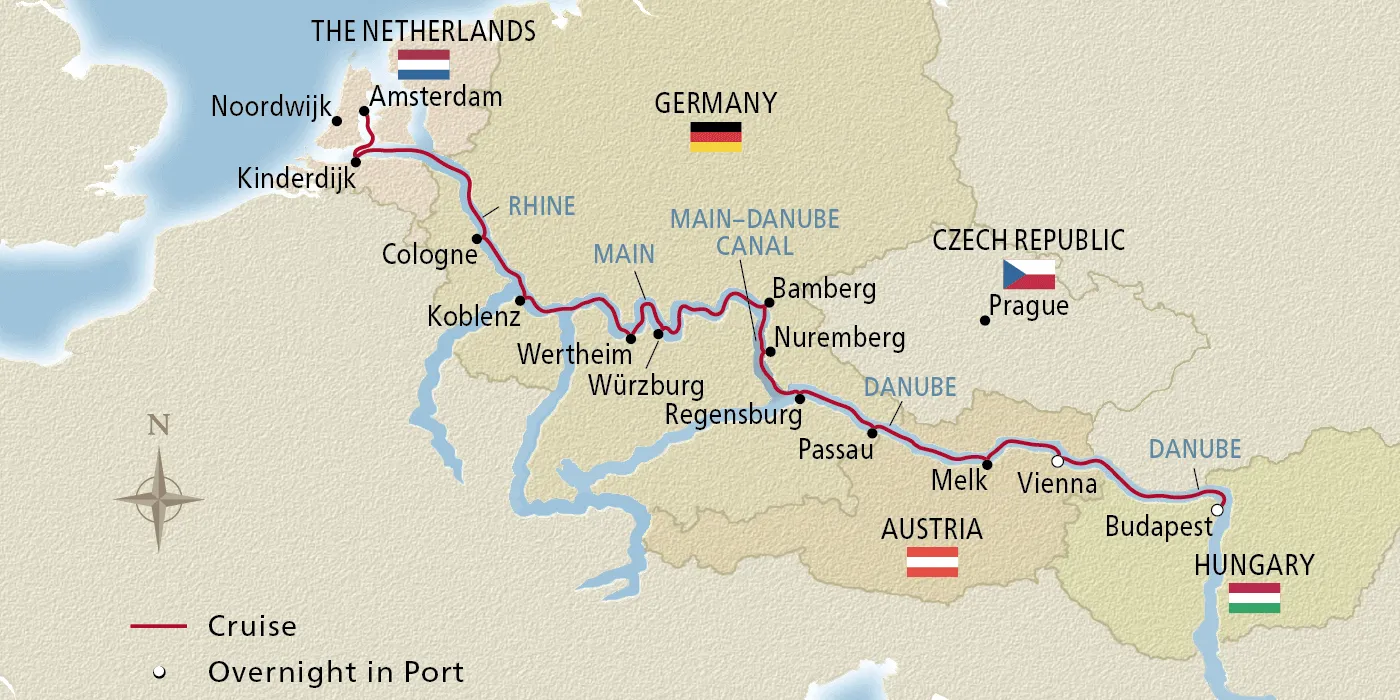
Admire Rhine Valley vistas from a 900-year-old castle. Sample the culinary delights of Austria’s Wachau Valley. Learn the Viennese waltz, visit Melk’s Benedictine Abbey and ponder Nuremberg’s World War II history. Indulge your senses on this 15-day journey spanning the best of Europe, tracing the Rhine, Main and Danube Rivers between the windmill-dotted waterways of Holland and the stunning landscapes of Hungary, with engaging encounters at every bend.
Budapest, Hungary / Amsterdam, The Netherlands
2026 Sailings from March to November
2027 Sailings from April to November
* Please check with us for dates & pricing
Cruise fare from $7,499.00 per person
* Please check with us for dates & pricing

Budapest, Hungary
Embark your ship and settle into your stateroom. Riverside beauty and a vibrant cultural scene blend together in Budapest to form one of Europe’s most rewarding cities. Hungary’s enchanting capital straddles the banks of the Danube, with traditional hillside Buda on one side and modern Pest on the other. By day, stunning art nouveau buildings, stalwart castles and grand palaces set the stage for inspiring strolls and long soaks in thermal spas. By night, the shimmering lights of the Parliament building dance across the waters of the Danube, the Chain Bridge uniting it all as a dramatic centerpiece.
* Ground transfers are included with Viking Air purchase.
Budapest, Hungary
Budapest’s old town is a fascinating medieval patchwork of narrow streets and colorful houses. In the Castle District, the Matthias Church soars in Gothic glory. Adjacent, the expansive wall and seven turrets of Fisherman’s Bastion overlook the Danube, the graceful Chain Bridge and the Pest side of the river. The centerpiece of the district is the sprawling Buda Castle. Constructed in the 13th century and expanded to its current baroque splendor during the 18th century, this edifice was home to Hungary’s kings for almost 700 years.
Shore Excursions – Panoramic Budapest
Duration: 3 hours 30 minutes
Take in one of Europe’s great cultural capitals and see its iconic sights. Over the last few decades, Budapest has reemerged as one of the continent’s iconic cities, divided by the Danube River and connected by the graceful Chain Bridge. Meet your guide for a panoramic tour, beginning in modern Pest. Along the elegant Andrássy Avenue, admire the National Opera House. Pass Heroes’ Square, a spacious plaza of monuments and statues commemorating the Magyar state. Across the river, explore the more traditional Buda side of the city. Here, visit the Castle District with its massive hilltop castle complex, the turreted Fisherman’s Bastion and Matthias Church. From the heights of Buda Hill, take in views of the famous Chain Bridge. Afterward, enjoy free time to explore the enchanting Buda Hill Castle area at your leisure, before returning to your ship.
Vienna, Austria
Renowned as the “City of Waltzes,” Austria’s capital city of Vienna is Europe’s center of classical music. Strauss and Mozart composed many of their finest pieces here. Vienna’s musical history is matched by the elegant, graceful architecture that lines the Ringstrasse, the wide boulevard encircling the Inner City. Baroque, neo-Renaissance, Gothic-Romanesque and other splendidly styled structures, from the Hofburg Palace to the Vienna State Opera, take the breath away with their grand facades. Vienna has a more intimate side too: inviting footpaths lead through green parks and its famed Viennese cafés sweeten any stay with coffee and the city’s delectable Sachertorte.
Vienna, Austria
Vienna is considered one of Europe’s greatest cultural hubs. Its art scene has long been established with the Hapsburg’s collection of fine art, now housed at the Kunsthistorisches Museum. Today, Vienna’s modern side showcases street art murals that don the side of buildings along the banks of the Danube. Ingrained in local life is the long-embraced tradition of coffeehouses; UNESCO includes Viennese coffeehouse culture on its list of Intangible Cultural Heritages. It is considered one of life’s pleasures to while away an afternoon over an Einspänner coffee and a pastry.
Shore Excursions – Panoramic Vienna
Duration: 3 hours 30 minutes
See the magnificent architectural highlights of one of Europe’s most elegant and romantic cultural capitals. Vienna was center of arts and intellect during the reign of the Hapsburgs and beyond. Meet your guide and drive into the city for a motor coach and walking tour, focusing on the splendid buildings on the Ringstrasse, the gracious boulevard laid out on the site of the old city walls during the mid-19th century. Imposing palaces, elegant public buildings and grand residences line this world-famous avenue. See the magnificent Hofburg Palace, winter residence of the Hapsburgs and home of the Spanish Riding School with its Lipizzaner horses. Admire the Gothic St. Stephen’s Cathedral, crowned with a gleaming spire and colorful roof tiles. And view the beautiful Vienna State Opera concert hall, its facade adorned with elaborate frescoes depicting Mozart’s opera The Magic Flute.
Scenic Sailing: Wachau Valley
Sail through a serene tapestry of terraced vineyards, forested slopes, charming towns and castle ruins in Austria’s Wachau Valley, celebrated as perhaps the most scenic stretch of the Danube. Journey 18 miles through this vast UNESCO World Heritage Site, where the river courses through picturesque hillsides. Gaze upon the prolific grapevines and quaint wine-producing villages hugging the shores—the legacy of vintners that stretch as far back as Celtic and Roman times and an echo of the more than 30 monasteries that served as vineyards in Renaissance days.
Melk, Austria
Set amid an important wine-growing region of picturesque villages and fairy-tale castles, the charming city of Melk lies at the base of the Wachau Valley. An imposing 900-year-old Benedictine abbey, a stunning example of baroque architecture, overlooks the town from its dramatic hilltop location. This architectural treasure has 365 windows, one for each day of the year, and the views from its expansive balcony are stunning. Its beautiful library houses priceless medieval manuscripts and marvelous frescoes by Paul Troger, and its meticulously kept grounds are inviting and picturesque.
Shore Excursions – Melk Abbey
Duration: 3 hours
Tour the renowned Melk Abbey, a masterwork of baroque brilliance. Perched on dramatic cliffs high above the Danube, this ochre-colored confection is perhaps the most graceful landmark of the Wachau Valley. At the abbey’s entrance, you will meet your guide. Rebuilt during the 18th century after the original 12th-century building was destroyed by fire, its library is now home to a wide range of medieval manuscripts. The interior of the abbey’s church is a kaleidoscope of red, orange and gold, with a magnificent carved pulpit and colorful ceiling frescoes. You will also see the imperial rooms, which are now home to a museum chronicling the abbey’s history from its inception to modern times. Be sure to step onto its gracious terrace for breathtaking views of the Danube, the city and the expanding valley.
Passau, Germany
Founded by the Celts over 2,000 years ago, Passau is one of Bavaria’s oldest cities. Known as the “City of Three Rivers,” it rests at the confluence of the Inn, Ilz and Danube rivers. The city has long enjoyed its strategic position and grew to great economic and political power because of it. The legacy of its past prosperity lives on in graceful arcades, colorful houses with rococo facades and the glorious baroque St. Stephen’s Cathedral, home to one of Europe’s largest pipe organs. Passau is also where two nations meet; it is here that the German-Austrian border begins.
Shore Excursions – Passau Walking Tour
Duration: 1 hour 30 minutes
Explore the Italianate-style streets of Passau, where three European rivers converge. Meet your local guide and begin your walking tour through delightful old-world streets, taking in a pastel rainbow of building facades as you stroll. You will see the impressive Bishops’ Residenz from which powerful prince-bishops ruled secular and religious life for hundreds of years. Continue past the 14th-century Rathaus, or Town Hall, built on the site of a former fish market on the Danube. Conclude your walk at the magnificent 17th-century St. Stephen’s Cathedral. This baroque wonder houses Europe’s largest pipe organ, with more than 17,000 pipes, and inspired Franz Liszt to write his Hungarian Coronation Mass. Enjoy free time to explore more of the city on your own before returning to your awaiting ship.
Bamberg, Germany
Having escaped major damage during World War II, the picturesque town of Regensburg is one of Europe’s best-preserved medieval cities, the oldest city along the Danube and a UNESCO World Heritage Site. The Old Stone Bridge, constructed in the 12th century, is a masterpiece of medieval engineering with its 16 arches. St. Peter’s Cathedral is widely considered Bavaria’s best Gothic architectural work. The old town’s Neupfarrplatz square is a cross section of history—it was once a thriving Jewish quarter, a bustling marketplace and the site of Nazi book burnings.
Shore Excursions – Regensburg Walking Tour
Duration: 1 hour 30 minutes
Witness a true medieval city untouched by World War II bombing and rich in architectural splendor. Regensburg is one of Germany’s best-preserved cities and a UNESCO World Heritage Site. To get to know this gem, explore it on foot with a local guide, who will share a personal view of the city he knows so well. See some of the city walls erected by Marcus Aurelius upon its founding. Pass the Old Town Hall and see the 12th-century Old Stone Bridge, a 16-arch marvel of medieval engineering that still carries traffic today. See the famous Alte Wurstküche (Old Sausage Kitchen), Germany’s oldest restaurant, and admire its idyllic courtyards. At the Gothic St. Peter’s Cathedral, gaze up at the Donkey Tower, a remnant of the former cathedral that was left to support this one. Marvel at the structure’s superb stained glass windows before returning to your ship at your leisure.
Shore Excursions – Historic Regensburg & Jewish Heritage
Duration: 2 hours
Discover Regensburg during a walking tour and learn more about the city’s Jewish heritage. This tour contains all the same elements as the regular Regensburg Walking Tour but adds stops at several Jewish-related sights. Meet your guide at the pier and set off on foot, admiring Roman-era ruins and the many landmarks that date back to the Middle Ages. Continue your journey, delving into the city’s Jewish heritage, with stops at important monuments. Learn more about its history at Neupfarrplatz, in what was once the Jewish Quarter. Here, where the Synagogue once stood, is the site of a striking memorial. You will also see the former residence of Oskar Schindler, who saved more than 1,200 Jews, and the tombstones at the Old Town Hall and the Stumbling Stones memorial. These small brass plaques on the pavement commemorate the Jewish residents who died in the Holocaust.
Scenic Sailing: Main-Danube Canal, Germany
As far back as 1,200 years ago, visionary Frankish Emperor Charlemagne contemplated connecting the Rhine, Main and Danube Rivers so ships could travel the length of Europe. Today, his dream dramatically comes to life. The Main-Danube Canal employs 16 stair-step river locks that allow vessels to travel 2,200 miles through 10 countries, from the North Sea coast of Holland to the Black Sea shores of Romania.
Nuremberg, Germany
The second-largest city in Bavaria, Nuremberg is filled with traditional half-timbered houses and Gothic churches with intricate spires. Although nearly destroyed during World War II, the remaining medieval city walls stretch some three miles and feature original gateways and 80 original watchtowers. Nuremberg is well known historically for its metal and toy craftsmanship. But it is infamous for its role in World War II, first as the site of Zeppelin Field’s Nazi rallies and later as the site of the war crimes trials at the Palace of Justice that captured the attention of a generation.
Shore Excursions – Nuremberg Through History
Duration: 4 hours
Tour one of Germany’s most renowned and intriguing cities on this included excursion. Meet your guide and drive to the Old Town, where you can delve into Nuremberg’s complex past. This medieval city is still surrounded by 14th-century walls, with many gates and watchtowers fully intact. It grew into a toy-making capital of Europe, where craftsmen also shaped metal into sculpture and carved wood and other materials into decorative crafts. See the grounds on which Nazi rallies were staged and pass the Palace of Justice, then admire the Imperial Palace, one of Europe’s most formidable fortresses. Then, stroll down the hill past half-timbered houses and browse the stalls at the Market Square. One of Europe’s most celebrated, it is famous for its gingerbread and its Gothic Schöner Brunnen, or Beautiful Fountain. Cap your tour with free time to explore on your own.
Bamberg, Germany
Founded in 902, Bamberg remains a medieval-looking city known for its symphony orchestra and rauchbier, specialty smoked beer. The city’s winding streets are filled with baroque patrician houses and are home to the stunning 11th-century Cathedral of Holy Roman Emperor Heinrich II, housing his tomb and that of Pope Clement II. Bamberg is especially noted for its Altes Rathaus, or Old Town Hall, situated on a twin-arched bridge over the Regnitz River, and for the old bishop’s houses: the 16th-century Alte Hofhaltung (Old Court) and 17th-century Neue Residenz (New Residence).
Shore Excursions – Bamberg Walking Tour
Duration: 4 hours 30 minutes
Delve into the history of Bamberg during an informative walk to view historic sights. Join your guide and head to the medieval city center, a UNESCO World Heritage Site. Pass by the magnificent 11th-century cathedral with its four imposing towers. The church was rebuilt in the late Romanesque and early Gothic style during the 13th century. Stop to admire the detailed statue of the Bamberger Reiter, or Bamberg Horseman, here. Then, see the Bamberg New Residence with its rose garden and panoramic views of the old town, as well as the picturesque Rathaus, or town hall, built in the middle of a double-arched bridge over the Regnitz River. From here, you can see fishermen’s cottages on the nearby riverbanks. Enjoy time to follow your own whims in Bamberg, perhaps sampling some of the town’s distinctive rauchbier, or smoke-flavored beer, before rejoining your ship.
Würzburg, Germany
Surrounded by Franconian vineyards, Würzburg was heavily damaged during World War II, but has since been completely restored. This prestigious university city is a jewel of baroque architecture. Its most pristine example of pomp and glory is the great Bishops’ Residenz palace, built in 1744 for the prince-bishop; his unwavering support of artists is evidenced by the sweeping staircase and magnificent ceiling frescoes by Tiepolo. Other landmarks include the medieval, statue-lined Old Main Bridge and Marienberg Fortress, originally a Celtic hill fort and later residence of the bishops. The city remains a major wine-making center, hosting Germany’s oldest and largest vineyard.
Shore Excursions – Würzburg Residenz & Walk
Duration: 3 hours
Tour Würzburg’s Bishops’ Residenz, one of Germany’s ornate palaces and a UNESCO World Heritage Site. Drive with your guide to the former residence of the Würzburg prince-bishop that was built over a 25-year period, beginning in 1719. Admire the overhead ceiling with its stunning, 6,400-square-foot “Four Continents” fresco painted by Venetian artist Giovanni Tiepolo. You will see several of the building’s ornate rooms, the colonnaded chapel and the baroque and English-style gardens lined with ornate statues. A highlight is sure to be the Mirror Cabinet. Incredibly, the entire complex was meticulously reconstructed after suffering extensive damage from World War II bombing. Afterward, continue to the Old Town of Würzburg, where a walking tour shows you the stunning Romanesque Cathedral, the Neumünster church, the market square and Town Hall, and the oldest wine bar in town.
Wertheim, Germany
Situated at the confluence of the Main and Tauber Rivers, Wertheim is a charming town brimming with history. The dukes of Wertheim built a castle at this strategic spot in the 12th century. It was captured and destroyed during the Thirty Years’ War, but it is still impressive today, peering down upon the medieval town center and half-timbered houses from its perch. Its Pointed Tower has guarded the junction of the Main and Tauber Rivers for 800 years. Known as a successful merchants’ town during the Middle Ages, today Wertheim is famous for its Franconian wines.
Shore Excursions – Wertheim Walking Tour
Duration: 1 hour
Explore Wertheim, a tiny town that has played a strategic role at the confluence of the Main and Tauber Rivers. You will join your guide to experience this quaint village, squeezed into a narrow triangle in the shadow of Wertheim Castle. As you stroll, its red sandstone towers and fortifications mark your progress from their perch, striking a dramatic pose against the lush hillside forest. You will walk past the Pointed Tower, round at the bottom and octagonal at the top. Over its 800 years, it has tilted to one side. Amble among beautifully restored half-timbered houses built in Franconian style. At the historic marketplace, you will pass a bakery and butcher shop, where you may stop after your tour to learn more about how these important professions help uphold German traditions. You can also stop by a glassblowing shop to admire the intricate works.
Scenic Sailing: Main River, Spessart
Journey along one of Germany’s most important waterways today, passing landscapes that embody the country’s scenic beauty and storybook charm. You will sail by quaint riverside villages, undulating farm country and the sylvan forests of the Spessart woodlands. Along the way, you just may lose yourself in the dreamy canvases of half-timbered houses, historic castles and splendid palaces. This is the Germany once ruled by dukes and brought to magical life by the imagination of the Brothers Grimm, who grew up in the town of Hanau and wove fantastic tales from these banks.
Scenic Sailing: Middle Rhine
The Rhine River flows through one of Germany’s most scenic regions. As you sail its most picturesque stretch, the UNESCO World Heritage Site of the Middle Rhine, you will pass vineyard-blanketed hills whose steep slopes require vintners to pick grapes by hand, keeping a centuries-old tradition alive. Splendid castles line the banks, all of which have stories to share, and the Lorelei Rock presides at a dramatic curve in the river. This infamous river maiden mesmerized sailors with her song and lured them to their demise at her feet.
Koblenz, Germany
Koblenz is a traditional German city, founded more than 2,000 years ago. This former trading settlement rests on a massif of the Middle Rhine Highlands. Its cobblestone streets, wood-beamed houses adorned with flowers, ancient market square and medieval churches recall the fairy-tale Germany of old. At the German Corner, a massive equestrian statue of Prince William I observes the lovely riverside scene. The famed Teutonic Knights set up their first base here in 1216. The Romanesque Basilica of St. Castor, Koblenz’s oldest building, dates to 836.
Shore Excursions – Historic Koblenz
Duration: 2 hours
Take a leisurely stroll around Koblenz and explore its historic past. You will meet your guide and begin your tour at Deutsches Eck, the city’s famed German Corner. Jutting into the waters like the prow of a ship where the Rhine and Moselle Rivers meet, this public park is home to a popular equestrian statue of Emperor Wilhelm I. After time to admire the sculpture, continue your walk among the narrow streets. Visit Jesuitsenplatz, or Jesuit Square, in the heart of the Old Town and named after the religious order of the same name. Admire the beautiful old school that sits on the eastern side of the square, and has been used as Koblenz City Hall since 1895. As you explore, your guide will point out influences from ancient Rome, the Middle Ages and the Napoleonic era.
Cologne, Germany
Cologne reveals its Roman heritage in its city layout and the ancient ruins that lie scattered through the town. Cologne’s modern plazas and Hohe Strasse host welcoming shops, enticing restaurants and cologne boutiques. Of note is the city’s 13th-century cathedral, a stunning example of Gothic artistry and a UNESCO World Heritage Site. Having survived Allied bombs during World War II, the cathedral’s imposing twin spires are visible for miles and its stained glass windows fill the interior with brilliant colored light. Its steps lead to a platform with astounding views.
Shore Excursions – Cologne Walking Tour
Duration: 2 hours
Learn about Cologne’s heritage and view its iconic cathedral, towering over the city in all its Gothic splendor. Step into a rich past, following the city’s preserved historic street patterns and hearing about its Roman and medieval history along the way. As you stroll, your guide will regale you with tales of local folklore figures, Tünnes and Schääl, and the city’s flourishing Jewish community. In Old Cologne, pass the elegant silhouette of St. Martin’s church and stop to view Cologne’s magnificent Gothic cathedral, a UNESCO World Heritage Site. Construction of this towering structure began in 1248 and continued in stages over the next seven centuries. The largest Gothic cathedral in Northern Europe, this magnificent church boasts two soaring spires and beautiful stained-glass windows, and survived the Allied bombings that ravaged the city and the rest of Germany during World War II.
Scenic Sailing: Waal & Merwede
Sail the bucolic waters of the Rhine, deep into the Rhine–Meuse–Scheldt Delta, as classic Dutch landscapes unfurl all around. Flat farmland, charming windmills and svelte poplar trees line the shores, and vast tracts of land stretch in all directions, growing all manner of bounty, from tomatoes to tulips. Gaze upon Friesian cows and tidy villages with their neatly laid farmhouses and marvel at how much of this land was reclaimed from the sea, with the aid of traditional windmills and the construction of dikes.
Kinderdijk, The Netherlands
Kinderdijk is a village community in the Alblasserwaard province. This corner of South Holland, part of the scenic Waal and Merwede regions, has long been shaped by Rhine Delta waters. Kinderdijk is most known for its 19 remarkably preserved 18th-century windmills. The charming hamlet is located amid low-lying polders, tracts of land reclaimed from the sea by the power of the windmills and enclosed by embankments, or dikes. This legendary place calls to mind the 1865 novel Hans Brinker, in which a heroic boy plugs his finger into a ruptured dike.
Shore Excursions – Kinderdijk Windmills
Duration: 2 hours
See the picturesque Dutch countryside and the original technological marvels of historic Kinderdijk. You will walk with your guide into the serene polder lands of South Holland. As you cross the dike to the windmills, you will notice that they in fact are at a lower elevation than your ship, as much of this part of The Netherlands is below sea level. Built in the mid-18th century, these 19 windmills, the largest concentration in The Netherlands, stand like sentinels on a hushed landscape. You will learn why they were built and see firsthand how they work, even stepping into a working windmill to observe its mechanics and living quarters. Families who live in these mills are required to keep them in working order. This excursion provides a revealing look at these marvelous buildings that helped shape the legendary Dutch landscape.
Amsterdam, The Netherlands
Bid farewell to your fellow guests and journey home. Or spend more time exploring, perhaps joining one of our extensions.
* Ground transfers are included with Viking Air purchase.
*12 Guided Tours: One shore excursion included per port; all others available at an extra charge.