Explore 3 rivers & 8 countries
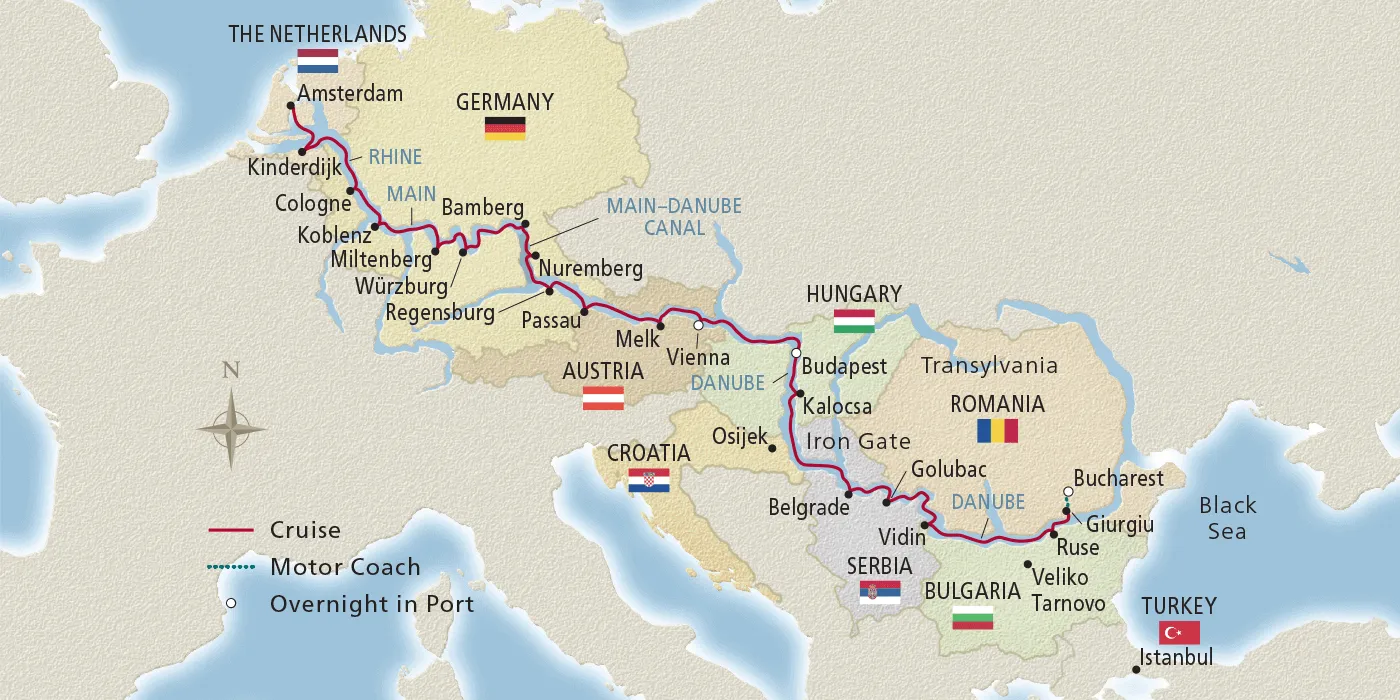
Sail Amsterdam’s canals. See castles on the Rhine. Behold the grandeur of Vienna. Celebrate folk traditions in Hungary, Croatia, Serbia, Bulgaria and Romania. These travel icons—and more—await you on a 23-day journey combining our Grand European Tour and Passage to Eastern Europe cruises. Discover eight countries in Western, Central and Eastern Europe while cruising the Rhine, Main and Danube. Enjoy a lifetime’s worth of experiences on a single voyage.
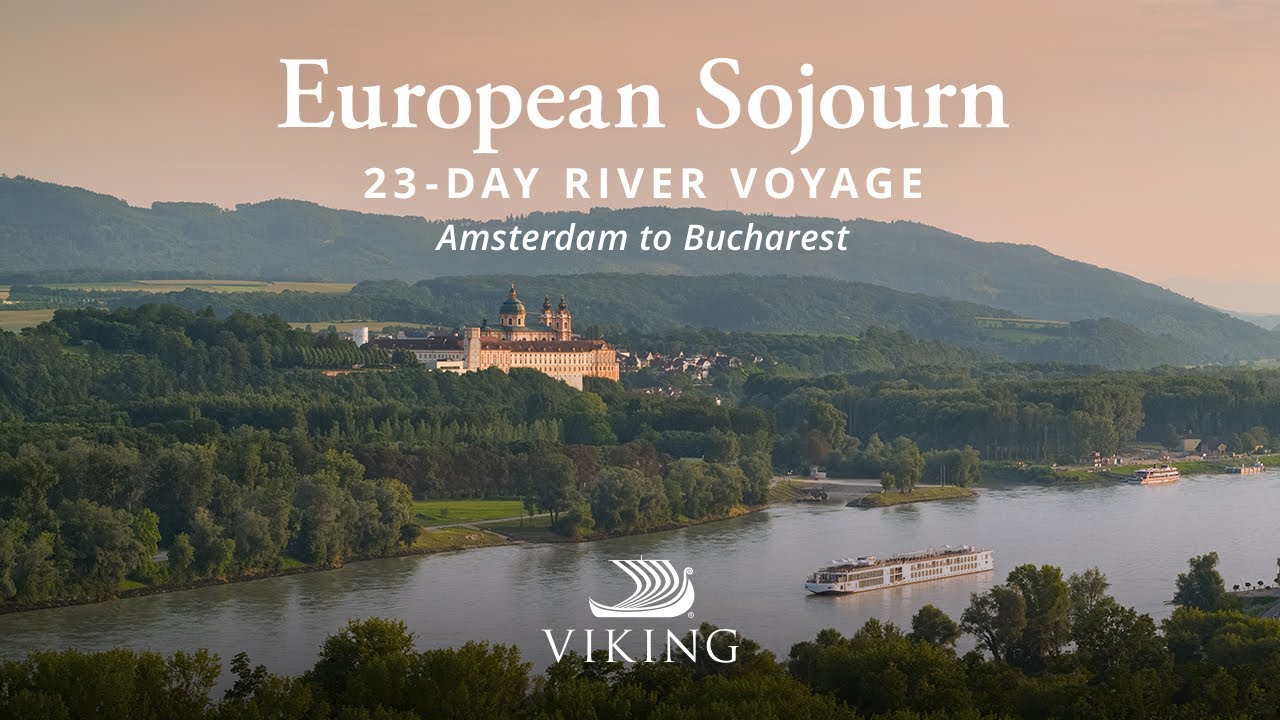
Amsterdam, The Netherlands / Bucharest, Romania
2026 Sailings from April to October
2027 Sailings from May to October
* Please check with us for dates & pricing
Cruise fare from $13,099.00 per person
* Please check with us for dates & pricing

Amsterdam, The Netherlands
Embark your ship and settle into your stateroom. A city of charming canals, elegant gabled houses, splendid museums and abundant bicycles, the Dutch capital of Amsterdam is a delight to explore. Its patchwork of waterways forms about 90 islands connected by 1,500 bridges. The legacy of the Dutch Golden Age lives on in gilded manses and in the lush paintings of Rembrandt and other Dutch masters that adorn the Rijksmuseum, The Netherlands’ grand repository of art and cultural history. Discovering Amsterdam is a pleasure best pursued on foot; visitors line the tranquil canals and linger over Dutch pancakes, or take a stroopwafel to go.
* Ground transfers are included with Viking Air purchase.
Kinderdijk, The Netherlands
Kinderdijk is a village community in the Alblasserwaard province. This corner of South Holland, part of the scenic Waal and Merwede regions, has long been shaped by Rhine Delta waters. Kinderdijk is most known for its 19 remarkably preserved 18th-century windmills. The charming hamlet is located amid low-lying polders, tracts of land reclaimed from the sea by the power of the windmills and enclosed by embankments, or dikes. This legendary place calls to mind the 1865 novel Hans Brinker, in which a heroic boy plugs his finger into a ruptured dike.
Shore Excursions – Kinderdijk Windmills
Duration: 2 hours
See the picturesque Dutch countryside and the original technological marvels of historic Kinderdijk. You will walk with your guide into the serene polder lands of South Holland. As you cross the dike to the windmills, you will notice that they in fact are at a lower elevation than your ship, as much of this part of The Netherlands is below sea level. Built in the mid-18th century, these 19 windmills, the largest concentration in The Netherlands, stand like sentinels on a hushed landscape. You will learn why they were built and see firsthand how they work, even stepping into a working windmill to observe its mechanics and living quarters. Families who live in these mills are required to keep them in working order. This excursion provides a revealing look at these marvelous buildings that helped shape the legendary Dutch landscape.
Scenic Sailing: Waal & Merwede
Sail the bucolic waters of the Rhine, deep into the Rhine–Meuse–Scheldt Delta, as classic Dutch landscapes unfurl all around. Flat farmland, charming windmills and svelte poplar trees line the shores, and vast tracts of land stretch in all directions, growing all manner of bounty, from tomatoes to tulips. Gaze upon Friesian cows and tidy villages with their neatly laid farmhouses and marvel at how much of this land was reclaimed from the sea, with the aid of traditional windmills and the construction of dikes.
Cologne, Germany
Cologne reveals its Roman heritage in its city layout and the ancient ruins that lie scattered through the town. Cologne’s modern plazas and Hohe Strasse host welcoming shops, enticing restaurants and cologne boutiques. Of note is the city’s 13th-century cathedral, a stunning example of Gothic artistry and a UNESCO World Heritage Site. Having survived Allied bombs during World War II, the cathedral’s imposing twin spires are visible for miles and its stained glass windows fill the interior with brilliant colored light. Its steps lead to a platform with astounding views.
Shore Excursions – Cologne Walking Tour
Duration: 2 hours
Learn about Cologne’s heritage and view its iconic cathedral, towering over the city in all its Gothic splendor. Step into a rich past, following the city’s preserved historic street patterns and hearing about its Roman and medieval history along the way. As you stroll, your guide will regale you with tales of local folklore figures, Tünnes and Schääl, and the city’s flourishing Jewish community. In Old Cologne, pass the elegant silhouette of St. Martin’s church and stop to view Cologne’s magnificent Gothic cathedral, a UNESCO World Heritage Site. Construction of this towering structure began in 1248 and continued in stages over the next seven centuries. The largest Gothic cathedral in Northern Europe, this magnificent church boasts two soaring spires and beautiful stained-glass windows, and survived the Allied bombings that ravaged the city and the rest of Germany during World War II.
Koblenz, Germany
Koblenz is a traditional German city, founded more than 2,000 years ago. This former trading settlement rests on a massif of the Middle Rhine Highlands. Its cobblestone streets, wood-beamed houses adorned with flowers, ancient market square and medieval churches recall the fairy-tale Germany of old. At the German Corner, a massive equestrian statue of Prince William I observes the lovely riverside scene. The famed Teutonic Knights set up their first base here in 1216. The Romanesque Basilica of St. Castor, Koblenz’s oldest building, dates to 836.
Shore Excursions – Marksburg Castle
Duration: 3 hours
Visit the only castle in the Rhine Valley to have never been destroyed. You will drive with your guide to Braubach, where the incredible Marksburg Castle watches over the town as it has since the 13th century. Because this magnificent structure was built with strong fortifications, it was never besieged by enemies. Upon arrival on its lofty grounds, enjoy spectacular views of Braubach, the Rhine and the surrounding countryside from its 300-foot perch. Tour the citadel, see the impressive kitchens in the Gothic Hall building and study the Gimbel Collection, including its life-size figurines detailing changes to armor and weaponry through the ages. The distinct butter-churn tower, so named because the upper reaches have a smaller diameter than the lower, is a beloved landmark of the town with its distinct profile. Today, Marksburg Castle is home to the German Castles Association, which works to preserve medieval fortifications all over Germany.
Scenic Sailing: Middle Rhine
The Rhine River flows through one of Germany’s most scenic regions. As you sail its most picturesque stretch, the UNESCO World Heritage Site of the Middle Rhine, you will pass vineyard-blanketed hills whose steep slopes require vintners to pick grapes by hand, keeping a centuries-old tradition alive. Splendid castles line the banks, all of which have stories to share, and the Lorelei Rock presides at a dramatic curve in the river. This infamous river maiden mesmerized sailors with her song and lured them to their demise at her feet.
Scenic Sailing: Main River, Spessart
Journey along one of Germany’s most important waterways today, passing landscapes that embody the country’s scenic beauty and storybook charm. You will sail by quaint riverside villages, undulating farm country and the sylvan forests of the Spessart woodlands. Along the way, you just may lose yourself in the dreamy canvases of half-timbered houses, historic castles and splendid palaces. This is the Germany once ruled by dukes and brought to magical life by the imagination of the Brothers Grimm, who grew up in the town of Hanau and wove fantastic tales from these banks.
Miltenberg, Germany
The Franconian town of Miltenberg on the Main River is lively and romantic, nestled amid one of Germany’s fine wine-producing regions. Along its cobblestone streets and crooked lanes, medieval timber-framed houses are plentiful, giving a feeling of stepping back in time. The 13th- to 14th-century Miltenberg Castle dominates the town and the beautiful Renaissance Zum Riesen inn, hosting travelers since 1411, stands out for its rich history. The town prospered when it gained escort rights along the Main River; two forts once guarded the river crossing here.
Shore Excursions – Miltenberg Walking Tour
Duration: 1 hour 30 minutes
Take in the fairy-tale charms of Miltenberg, one of Germany’s most delightful riverside towns. Begin your tour in the Old Town, following its cobblestone streets past medieval houses fronted with flower-bedecked balconies. The town square, lined with half-timbered facades, is one of the most picturesque in all of Germany, laid out on a narrow strip of land between the hills and manicured banks of the Main. Nearby, the handsome and richly hued hotel Zum Riesen (“Inn of the Giant”), Germany’s oldest inn, is a Renaissance treasure; it first opened its doors as a hotel in 1411 and has been open ever since. You will also see the Mainz and Würzburg town gates and catch a glimpse of Miltenberg Castle, built in the 13th and 14th centuries, high over the roofs of Miltenberg.
Würzburg, Germany
Surrounded by Franconian vineyards, Würzburg was heavily damaged during World War II, but has since been completely restored. This prestigious university city is a jewel of baroque architecture. Its most pristine example of pomp and glory is the great Bishops’ Residenz palace, built in 1744 for the prince-bishop; his unwavering support of artists is evidenced by the sweeping staircase and magnificent ceiling frescoes by Tiepolo. Other landmarks include the medieval, statue-lined Old Main Bridge and Marienberg Fortress, originally a Celtic hill fort and later residence of the bishops. The city remains a major wine-making center, hosting Germany’s oldest and largest vineyard.
Shore Excursions – Würzburg Residenz & Walk
Duration: 3 hours
Tour Würzburg’s Bishops’ Residenz, one of Germany’s ornate palaces and a UNESCO World Heritage Site. Drive with your guide to the former residence of the Würzburg prince-bishop that was built over a 25-year period, beginning in 1719. Admire the overhead ceiling with its stunning, 6,400-square-foot “Four Continents” fresco painted by Venetian artist Giovanni Tiepolo. You will see several of the building’s ornate rooms, the colonnaded chapel and the baroque and English-style gardens lined with ornate statues. A highlight is sure to be the Mirror Cabinet. Incredibly, the entire complex was meticulously reconstructed after suffering extensive damage from World War II bombing. Afterward, continue to the Old Town of Würzburg, where a walking tour shows you the stunning Romanesque Cathedral, the Neumünster church, the market square and Town Hall, and the oldest wine bar in town.
Bamberg, Germany
Founded in 902, Bamberg remains a medieval-looking city known for its symphony orchestra and rauchbier, specialty smoked beer. The city’s winding streets are filled with baroque patrician houses and are home to the stunning 11th-century Cathedral of Holy Roman Emperor Heinrich II, housing his tomb and that of Pope Clement II. Bamberg is especially noted for its Altes Rathaus, or Old Town Hall, situated on a twin-arched bridge over the Regnitz River, and for the old bishop’s houses: the 16th-century Alte Hofhaltung (Old Court) and 17th-century Neue Residenz (New Residence).
Shore Excursions – Bamberg Walking Tour
Duration: 4 hours 30 minutes
Delve into the history of Bamberg during an informative walk to view historic sights. Join your guide and head to the medieval city center, a UNESCO World Heritage Site. Pass by the magnificent 11th-century cathedral with its four imposing towers. The church was rebuilt in the late Romanesque and early Gothic style during the 13th century. Stop to admire the detailed statue of the Bamberger Reiter, or Bamberg Horseman, here. Then, see the Bamberg New Residence with its rose garden and panoramic views of the old town, as well as the picturesque Rathaus, or town hall, built in the middle of a double-arched bridge over the Regnitz River. From here, you can see fishermen’s cottages on the nearby riverbanks. Enjoy time to follow your own whims in Bamberg, perhaps sampling some of the town’s distinctive rauchbier, or smoke-flavored beer, before rejoining your ship.
Scenic Sailing: Main-Danube Canal, Germany
As far back as 1,200 years ago, visionary Frankish Emperor Charlemagne contemplated connecting the Rhine, Main and Danube Rivers so ships could travel the length of Europe. Today, his dream dramatically comes to life. The Main-Danube Canal employs 16 stair-step river locks that allow vessels to travel 2,200 miles through 10 countries, from the North Sea coast of Holland to the Black Sea shores of Romania.
Nuremberg, Germany
The second-largest city in Bavaria, Nuremberg is filled with traditional half-timbered houses and Gothic churches with intricate spires. Although nearly destroyed during World War II, the remaining medieval city walls stretch some three miles and feature original gateways and 80 original watchtowers. Nuremberg is well known historically for its metal and toy craftsmanship. But it is infamous for its role in World War II, first as the site of Zeppelin Field’s Nazi rallies and later as the site of the war crimes trials at the Palace of Justice that captured the attention of a generation.
Shore Excursions – Nuremberg Through History
Duration: 4 hours
Tour one of Germany’s most renowned and intriguing cities on this included excursion. Meet your guide and drive to the Old Town, where you can delve into Nuremberg’s complex past. This medieval city is still surrounded by 14th-century walls, with many gates and watchtowers fully intact. It grew into a toy-making capital of Europe, where craftsmen also shaped metal into sculpture and carved wood and other materials into decorative crafts. See the grounds on which Nazi rallies were staged and pass the Palace of Justice, then admire the Imperial Palace, one of Europe’s most formidable fortresses. Then, stroll down the hill past half-timbered houses and browse the stalls at the Market Square. One of Europe’s most celebrated, it is famous for its gingerbread and its Gothic Schöner Brunnen, or Beautiful Fountain. Cap your tour with free time to explore on your own.
Regensburg, Germany
Having escaped major damage during World War II, the picturesque town of Regensburg is one of Europe’s best-preserved medieval cities, the oldest city along the Danube and a UNESCO World Heritage Site. The Old Stone Bridge, constructed in the 12th century, is a masterpiece of medieval engineering with its 16 arches. St. Peter’s Cathedral is widely considered Bavaria’s best Gothic architectural work. The old town’s Neupfarrplatz square is a cross section of history—it was once a thriving Jewish quarter, a bustling marketplace and the site of Nazi book burnings.
Shore Excursions – Regensburg Walking Tour
Duration: 1 hour 30 minutes
Witness a true medieval city untouched by World War II bombing and rich in architectural splendor. Regensburg is one of Germany’s best-preserved cities and a UNESCO World Heritage Site. To get to know this gem, explore it on foot with a local guide, who will share a personal view of the city he knows so well. See some of the city walls erected by Marcus Aurelius upon its founding. Pass the Old Town Hall and see the 12th-century Old Stone Bridge, a 16-arch marvel of medieval engineering that still carries traffic today. See the famous Alte Wurstküche (Old Sausage Kitchen), Germany’s oldest restaurant, and admire its idyllic courtyards. At the Gothic St. Peter’s Cathedral, gaze up at the Donkey Tower, a remnant of the former cathedral that was left to support this one. Marvel at the structure’s superb stained glass windows before returning to your ship at your leisure.
Shore Excursions – Historic Regensburg & Jewish Heritage
Duration: 2 hours
Discover Regensburg during a walking tour and learn more about the city’s Jewish heritage. This tour contains all the same elements as the regular Regensburg Walking Tour but adds stops at several Jewish-related sights. Meet your guide at the pier and set off on foot, admiring Roman-era ruins and the many landmarks that date back to the Middle Ages. Continue your journey, delving into the city’s Jewish heritage, with stops at important monuments. Learn more about its history at Neupfarrplatz, in what was once the Jewish Quarter. Here, where the Synagogue once stood, is the site of a striking memorial. You will also see the former residence of Oskar Schindler, who saved more than 1,200 Jews, and the tombstones at the Old Town Hall and the Stumbling Stones memorial. These small brass plaques on the pavement commemorate the Jewish residents who died in the Holocaust.
Passau, Germany
Founded by the Celts over 2,000 years ago, Passau is one of Bavaria’s oldest cities. Known as the “City of Three Rivers,” it rests at the confluence of the Inn, Ilz and Danube rivers. The city has long enjoyed its strategic position and grew to great economic and political power because of it. The legacy of its past prosperity lives on in graceful arcades, colorful houses with rococo facades and the glorious baroque St. Stephen’s Cathedral, home to one of Europe’s largest pipe organs. Passau is also where two nations meet; it is here that the German-Austrian border begins.
Shore Excursions – Passau Walking Tour
Duration: 1 hour 30 minutes
Explore the Italianate-style streets of Passau, where three European rivers converge. Meet your local guide and begin your walking tour through delightful old-world streets, taking in a pastel rainbow of building facades as you stroll. You will see the impressive Bishops’ Residenz from which powerful prince-bishops ruled secular and religious life for hundreds of years. Continue past the 14th-century Rathaus, or Town Hall, built on the site of a former fish market on the Danube. Conclude your walk at the magnificent 17th-century St. Stephen’s Cathedral. This baroque wonder houses Europe’s largest pipe organ, with more than 17,000 pipes, and inspired Franz Liszt to write his Hungarian Coronation Mass. Enjoy free time to explore more of the city on your own before returning to your awaiting ship.
Melk, Austria
Set amid an important wine-growing region of picturesque villages and fairy-tale castles, the charming city of Melk lies at the base of the Wachau Valley. An imposing 900-year-old Benedictine abbey, a stunning example of baroque architecture, overlooks the town from its dramatic hilltop location. This architectural treasure has 365 windows, one for each day of the year, and the views from its expansive balcony are stunning. Its beautiful library houses priceless medieval manuscripts and marvelous frescoes by Paul Troger, and its meticulously kept grounds are inviting and picturesque.
Shore Excursions – Melk Abbey
Duration: 3 hours
Tour the renowned Melk Abbey, a masterwork of baroque brilliance. Perched on dramatic cliffs high above the Danube, this ochre-colored confection is perhaps the most graceful landmark of the Wachau Valley. At the abbey’s entrance, you will meet your guide. Rebuilt during the 18th century after the original 12th-century building was destroyed by fire, its library is now home to a wide range of medieval manuscripts. The interior of the abbey’s church is a kaleidoscope of red, orange and gold, with a magnificent carved pulpit and colorful ceiling frescoes. You will also see the imperial rooms, which are now home to a museum chronicling the abbey’s history from its inception to modern times. Be sure to step onto its gracious terrace for breathtaking views of the Danube, the city and the expanding valley.
Scenic Sailing: Wachau Valley
Sail through a serene tapestry of terraced vineyards, forested slopes, charming towns and castle ruins in Austria’s Wachau Valley, celebrated as perhaps the most scenic stretch of the Danube. Journey 18 miles through this vast UNESCO World Heritage Site, where the river courses through picturesque hillsides. Gaze upon the prolific grapevines and quaint wine-producing villages hugging the shores—the legacy of vintners that stretch as far back as Celtic and Roman times and an echo of the more than 30 monasteries that served as vineyards in Renaissance days.
Krems, Austria
A small university town at the eastern end of the Danube’s Wachau Valley, Krems is surrounded by terraced vineyards. In its heyday, during the 12th century, Krems held even more importance than Vienna for its iron, grain, salt and wine trade. As to the latter, the city has played a long and celebrated part in the popularity of the Wachau’s wine culture; the valley’s south slopes in Krems are bathed in sunlight all day and create some of the best Riesling and Veltliner wines in the world. The city’s cobblestone streets, taverns, wine bars and coffeehouses have a timeless appeal.
Vienna, Austria
Renowned as the “City of Waltzes,” Austria’s capital city of Vienna is Europe’s center of classical music. Strauss and Mozart composed many of their finest pieces here. Vienna’s musical history is matched by the elegant, graceful architecture that lines the Ringstrasse, the wide boulevard encircling the Inner City. Baroque, neo-Renaissance, Gothic-Romanesque and other splendidly styled structures, from the Hofburg Palace to the Vienna State Opera, take the breath away with their grand facades. Vienna has a more intimate side too: inviting footpaths lead through green parks and its famed Viennese cafés sweeten any stay with coffee and the city’s delectable Sachertorte.
Shore Excursions – Panoramic Vienna
Duration: 3 hours 30 minutes
See the magnificent architectural highlights of one of Europe’s most elegant and romantic cultural capitals. Vienna was center of arts and intellect during the reign of the Hapsburgs and beyond. Meet your guide and drive into the city for a motor coach and walking tour, focusing on the splendid buildings on the Ringstrasse, the gracious boulevard laid out on the site of the old city walls during the mid-19th century. Imposing palaces, elegant public buildings and grand residences line this world-famous avenue. See the magnificent Hofburg Palace, winter residence of the Hapsburgs and home of the Spanish Riding School with its Lipizzaner horses. Admire the Gothic St. Stephen’s Cathedral, crowned with a gleaming spire and colorful roof tiles. And view the beautiful Vienna State Opera concert hall, its facade adorned with elaborate frescoes depicting Mozart’s opera The Magic Flute.
Vienna, Austria
Vienna is considered one of Europe’s greatest cultural hubs. Its art scene has long been established with the Hapsburg’s collection of fine art, now housed at the Kunsthistorisches Museum. Today, Vienna’s modern side showcases street art murals that don the side of buildings along the banks of the Danube. Ingrained in local life is the long-embraced tradition of coffeehouses; UNESCO includes Viennese coffeehouse culture on its list of Intangible Cultural Heritages. It is considered one of life’s pleasures to while away an afternoon over an Einspänner coffee and a pastry.
Budapest, Hungary
Riverside beauty and a vibrant cultural scene blend together in Budapest to form one of Europe’s most rewarding cities. Hungary’s enchanting capital straddles the banks of the Danube, with traditional hillside Buda on one side and modern Pest on the other. By day, stunning art nouveau buildings, stalwart castles and grand palaces set the stage for inspiring strolls and long soaks in thermal spas. By night, the shimmering lights of the Parliament building dance across the waters of the Danube, the Chain Bridge uniting it all as a dramatic centerpiece.
Shore Excursions – Panoramic Budapest
Duration: 3 hours 30 minutes
Take in one of Europe’s great cultural capitals and see its iconic sights. Over the last few decades, Budapest has reemerged as one of the continent’s iconic cities, divided by the Danube River and connected by the graceful Chain Bridge. Meet your guide for a panoramic tour, beginning in modern Pest. Along the elegant Andrássy Avenue, admire the National Opera House. Pass Heroes’ Square, a spacious plaza of monuments and statues commemorating the Magyar state. Across the river, explore the more traditional Buda side of the city. Here, visit the Castle District with its massive hilltop castle complex, the turreted Fisherman’s Bastion and Matthias Church. From the heights of Buda Hill, take in views of the famous Chain Bridge. Afterward, enjoy free time to explore the enchanting Buda Hill Castle area at your leisure, before returning to your ship.
Budapest, Hungary
Budapest’s old town is a fascinating medieval patchwork of narrow streets and colorful houses. In the Castle District, the Matthias Church soars in Gothic glory. Adjacent, the expansive wall and seven turrets of Fisherman’s Bastion overlook the Danube, the graceful Chain Bridge and the Pest side of the river. The centerpiece of the district is the sprawling Buda Castle. Constructed in the 13th century and expanded to its current baroque splendor during the 18th century, this edifice was home to Hungary’s kings for almost 700 years.
Kalocsa, Hungary
Once the seat of the archbishop, the cultural center of Kalocsa is more than 1,000 years old. The quaint town, surrounded by 8,000 acres of farmland growing fiery red peppers, is brimming with traditional Hungarian culture and steeped in the piquant flavors of paprika, the “red gold” that has been giving local goulash its distinctive taste for centuries. The world’s first Paprika Museum chronicles the spice’s history. The streets are adorned with bright murals of floral motifs, which create a cheery ambience for browsing craft-filled shops. Hungary’s artistic heritage takes center stage at the House of Folk Arts museum.
Shore Excursions – Kalocsa & Puszta
Duration: 3 hours 30 minutes
Visit one of Hungary’s major cultural centers and attend a breathtaking display of traditional horsemanship. Depart your ship for a short drive to the city of Kalocsa, where a rich history is flavored by the town’s renowned peppery paprika. In Holy Trinity Square, you will see the splendid cathedral and admire the Archbishop’s Palace. After a short organ concert at St. Joseph Church, continue to the Bakodpuszta Equestrian Center. The people of the Hungarian Puszta region have long relied on horses for transportation, settlement and defense of their land. Many locals worry that their country’s equestrian connection is being lost to a motorized world, so they hold fast to rural ways and to their four-legged comrades, elevating horsemanship to an art form. Witness the sometimes acrobatic culmination of this long-cherished relationship during a thrilling show.
Osijek, Croatia
The fourth-largest city in Croatia, Osijek is located near the confluence of the Drava and Danube Rivers. It is the largest city and the economic and cultural capital of the eastern Croatian region of Slavonia. In its early days, Osijek was a Roman settlement called Mursa Maior (“major”). It was later rebuilt by the Ottomans and ruled by the Hapsburg Empire. Today, with an abundance of farmland and game, as well as plentiful baroque architecture and musical and outdoor venues, Osijek has become a gastronomic and cultural center of Croatia. Its cathedral can host 3,000 people.
Shore Excursions – Osijek & Vukovar
Duration: 4 hours 30 minutes
See the highlights of Vukovar and Osijek, and stop to meet a Croatian family along the way. Join your guide and make the short drive to Vukovar, passing the Vuka River, the palace of the former Count Eltz and the city’s main street, lined with buildings that carry echoes of Northern Europe. As you arrive in Osijek, pause to visit a local family in their home and learn about their daily lives. After, continue to the Osijek Citadel complex for a walking tour. Enjoy a concert in the Rising of the Holy Cross Church. Then explore Holy Trinity Square, see the town’s only surviving gate and stroll the picturesque promenade along the Drava River. See more of the town by motor coach, passing green parks and driving along European Avenue, the most scenic street in Osijek, lined with elegant baroque and Belle Époque buildings.
Belgrade, Serbia
The Serbian capital and former capital of the state of Yugoslavia, Belgrade is one of the oldest cities in Europe. Its location at the confluence of the Sava and Danube Rivers has long made it a contested region. Throughout its history, the “White City,” as its Serbian name translates, has been destroyed and rebuilt 20 times. Fortunately, the wide-reaching citadel remains, housing the Kalemegdan Fortress, Orthodox churches, Turkish baths and green parkland. Its Church of St. Sava is one of the largest Orthodox buildings in the world.
Shore Excursions – Panoramic Belgrade
Duration: 4 hours
See Belgrade’s monuments and architectural splendor during this enlightening tour of Europe’s most resilient city. The Serbian capital of Belgrade overlooks the confluence of the Danube and Sava Rivers. Ravaged and rebuilt 20 times in its history, many of the city’s finest buildings have been gloriously restored. Take a guided walk around the famed Kalemegdan Fortress. Its stalwart walls loom over the Old Town; impressive medieval gates enclose Orthodox churches, Turkish baths, a soaring monument to “The Victor” and more. Enjoy a stroll in the park around the fortress, taking in vistas of the river. Later, witness modern-day Belgrade during a panoramic drive and visit the Church of St. Sava, one of the world’s largest Orthodox churches. Stop in the Square of the Republic to admire the statue of Prince Michael and enjoy free time to browse stores in the adjacent pedestrian shopping area.
Golubac, Serbia
Millennia of history await at “the Town of Doves,” the gateway to the Djerdap National Park. The Iron Gate of the Danube lies between the mighty Carpathian and Balkan Mountains, its dramatic scenery carved by narrow ravines. Guarding the Danube is the imposing 14th-century Golubac Fortress, which has seen ruling empires vie for its control over the centuries, changing hands between the Serbs, Hungarians, Bulgarians and Turks. Serbian culture is swathed in tradition, and it is an integral part of the country’s identity that has carried its people through challenging times in history. Ancient civilizations to modern empires have left their mark, creating a unique, fascinating heritage that spans thousands of years.
Shore Excursions – Golubac Fortress by Foot
Duration: 1 hour
Admire sweeping views of the Danube River and its surroundings during a walking tour of Golubac Fortress. Disembark your ship at the pier and meet your guide, then take a short stroll to this fortified medieval town that sits along the shores of the mighty Danube. Explore the remnants of the high stone walls and looming square towers as your guide regales you with stories of the fortress’s history. Originally a Roman settlement, it was built during the 14th century; who built it remains a mystery, but its strategic position along the Danube made it a valuable prize for conquering armies throughout the centuries. Stop atop the ramparts to gaze across the Danube and revel in the natural beauty of the encircling landscape. After your walk, take a moment to appreciate your surroundings on your own before returning to your awaiting ship and continuing your cruise.
Scenic Sailing: The Iron Gate
Sail through one of Europe’s most dramatic natural wonders, the picturesque stretch famously known as the Iron Gate. Meander through narrow gorges that slice through the Carpathian Mountains to the north and the Balkan Mountains to the south, and marvel at the towering white limestone cliffs draped with forest. Be on the lookout for ancient remains upon the dramatic walls. On the Serbian side, Trajan’s Tablet was laid to mark the construction of a Roman military road; on the Romanian side, marvel at the enormous rock sculpture of Dacian king Decebalus.
Vidin, Bulgaria
One of Bulgaria’s oldest riverside towns, Vidin is home to the only entirely preserved medieval Bulgarian castle. Perched impressively on the riverbank, its striking pose, thick ring walls, stout towers and solid gates form a fortress known as Babini Vidini Kuli, which means Granny Vida’s Towers. Around the castle rose a fairy-tale town of 25 minarets, domes and other charming architecture of the period. Though many of these features have been shadowed by today’s city, Vidin retains its charms. Today it is largely an agricultural and trade center renowned for its wines.
Shore Excursions – Belogradchik Rocks and Fortress
Duration: 4 hours
Journey into one of Bulgaria’s most scenic regions to see how geography helped create an architectural treasure. Join your guide for a drive from Vidin to the Belogradchik Rocks. With their strange, red-hued cliffs and massifs, these stunning mountains strike a dramatic pose. The result of millennia of weathering, river erosion, freezing and countless other factors, these formations are more than Bulgaria’s great natural wonder. They are also a curiosity for the multitude of fantastic figures and profiles that emerge when you catch them at just the right angle. Silhouettes of people, towers, ships, mushrooms, palaces and animals populate the cliffs. You will also see the fascinating Belogradchik Fortress, built by the Ottomans in a maze of rock columns and pillars. Take a walk around the compound and enjoy superior views of the caves and rock shapes from its many terraced courtyards.
Ruse, Bulgaria
The most integral Danube city in Bulgaria, Ruse enjoys a setting amid a rolling countryside blanketed in sunflower and wheat fields. Once an outpost of the Roman Empire, it was known as Sexaginta Prista, or Sixty Ships, for the fleet that once docked here. Today, it is more known for its colorful atmosphere and as a gateway to Romania’s fabled Transylvania region. Best explored on foot, the city features many fine examples of 19th- and 20th-century neobaroque and neorococo architecture.
Shore Excursions – Veliko Tarnovo & Arbanasi
Duration: 8 hours 30 minutes
Tour two cultural gems rich in Bulgarian heritage during this full-day excursion into the heart of the country. Begin with a drive through Ruse, then continue to Veliko Tarnovo, a fascinating medieval town built around Tsarevets Hill and its castle. After a coffee break, stop at the Yantra River bridge for a nice view of the majestic Assenev Brothers monument, a towering obelisk flanked by horses. Next, explore Samovodska Charshia, a traditional street teeming with handicrafts, or visit the castle ruins and enjoy vistas of the Old Town and countryside. Afterward, proceed to Arbanasi, rich in history and Greek influence. After lunch at a local restaurant, sample the Damascus rose products, locally made from the essence of roses. After, you will visit a local merchant house and see the intricate frescoes of the Nativity Church with a local guide.
Shore Excursions – Ruse Highlights
Duration: 3 hours
Marvel at the architectural variety of “Little Vienna,” Bulgaria’s most important river port. Established in the 1st century, Ruse is a repository of neo-baroque, neo-rococo, Empire, Renaissance and Secession brilliance. During a guided excursion, pass the crimson-hued Opera House; the Liberty Monument, the symbol of the city completed around the turn of the 20th century; and the neoclassical Theater and Concert Hall. Continue to the baroque Old City Center, a collection of architectural styles, and the impressive Sveta Troitsa Church with its hexagonal tower. Then, browse the fascinating collection at the Museum of History, which houses 140,000 artifacts and items discovered in Danube castles. Stop at the engaging Ethnographic Museum, where you will learn what life was like in this corner of Bulgaria in the 19th century, then return to your ship.
Bucharest, Romania
After breakfast, disembark your ship and transfer to your destination. Bucharest is Romania’s cultural capital. Its original fortress, the first of many, was built to protect the Walachian state from the Turks. Today, it is a city of elegant French-style boulevards, lush gardens and green expanses, including the tranquil Bucharest Botanical Garden. The historic Lipscani district exudes the old-world charms of cobblestone alleys, inns and shops. The sprawling Palace of Parliament is the world’s largest civilian building, said to contain 3,000 rooms. Transfer to your hotel and settle into your room.
Shore Excursions – Bucharest & the Village Museum
Duration: 7 hours 30 minutes
Explore Romania’s fascinating capital, an impressive collection of unique architecture and grand monuments. Founded in the 14th century, Bucharest became Romania’s capital in 1859 with the merging of Moldavia and Walachia. See the city’s wide boulevards, the Romanian Athenaeum, the Arch of Triumph and the expansive Palace of Parliament—the largest civilian building in the world. Visit the outdoor Muzeul Satului, otherwise known as the Village Museum, where authentic dwellings from all regions of the country have been relocated and reassembled, including rural cottages, farmhouses and water mills. Head to the Old Town and wander amid its narrow streets before lunch at a local restaurant. Here, you will cap your excursion with a lively folkloric performance that recalls the simple pleasures of rural life.
Bucharest, Romania
Bid farewell to your fellow guests and journey home. Or spend more time exploring, perhaps joining one of our extensions.
*19 Guided Tours: One shore excursion included per port; all others available at an extra charge.