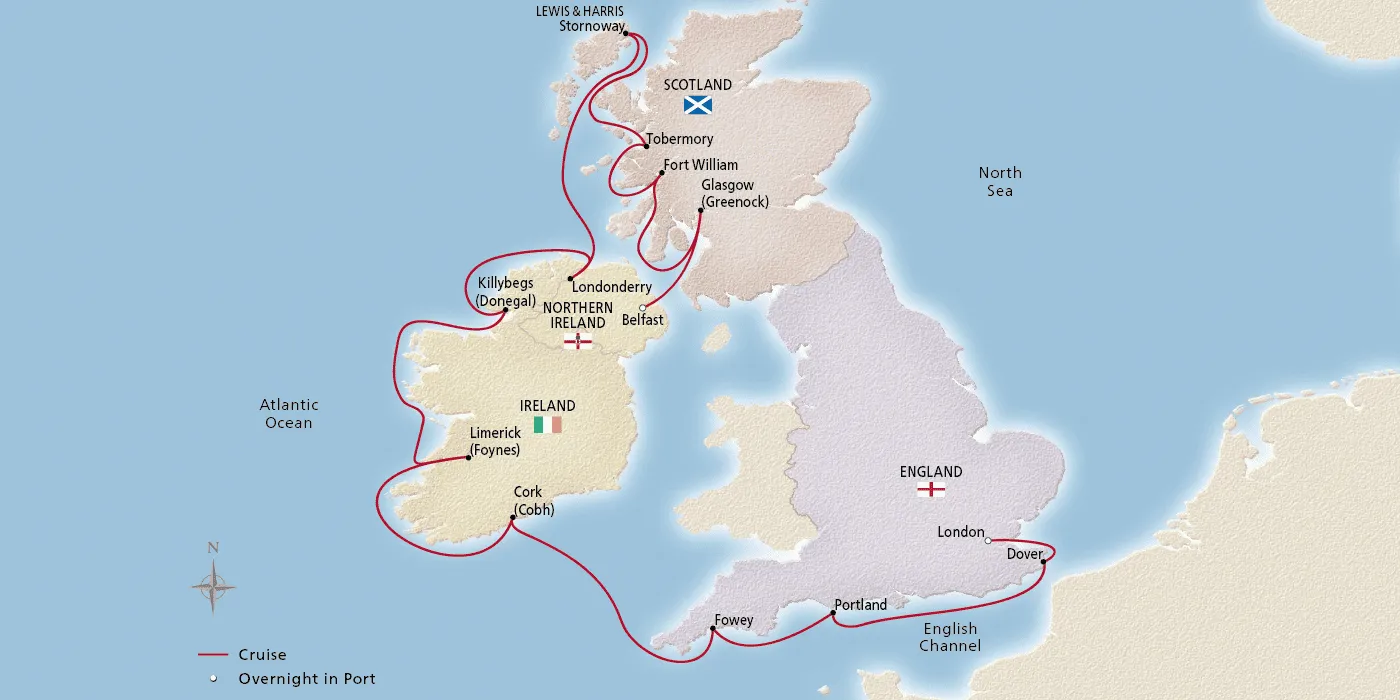
London (Greenwich), England / Belfast, Northern Ireland
2027 Sailings in April, May and from July to September
2028 Sailings from April to September
* Please check with us for dates & pricing
Cruise fare from $14,299.00 per person
* Please check with us for dates & pricing
London (Greenwich), England
Embark your ship and settle into your stateroom. Greenwich, a borough of London, is home to the Royal Observatory. From here, the world’s longitude is measured from the prime meridian, and Greenwich Mean Time sets the global time standard. At the port, the clipper ship Cutty Sark, one of Greenwich’s renowned historic landmarks, is preserved as a fascinating museum. Upriver, London is home to Buckingham Palace, the Houses of Parliament and Westminster Abbey. In addition, this major economic and cultural hub boasts a long tradition of arts and architectural innovation—from Shakespeare’s Globe Theater to West End musicals.
London (Greenwich), England
Greenwich is home to several iconic maritime institutions. Royal Naval College is a major symbol of Britain’s seafaring heritage and the architectural centerpiece of Greenwich. It opened as a hospital for sailors in 1712 and served as the Royal Navy’s educational institution from 1873 to 1998. Today, its hallowed halls whisper of the days when Britannia ruled the waves. The National Maritime Museum is the world’s largest, chronicling England’s seafaring endeavors in its compelling collection of art, maps and countless memorabilia, including the first marine chronometer.
Shore Excursions – Royal Greenwich by Foot
Duration: 1 hour 30 minutes
Discover Greenwich’s maritime and royal history by foot. You will join your guide for a walk that will take you past the famous Cutty Sark, the world’s only surviving tea clipper and the fastest sailing ship in the world when it was built in 1869, and the Greenwich Market, an eclectic mix of arts and crafts, and street food. Continue on to St. Alfege Church, dedicated to the archbishop of Canterbury who was killed on this spot in 1012 and where Henry VIII was baptized. Then, stop for photos at the Queen’s House, the first classical building built in England. See the National Maritime Museum, housed in a former royal palace and the world’s largest seafaring museum, and the iconic Old Royal Naval College, the architectural centerpiece of Maritime Greenwich, before returning to your ship.
Dover, England
Most famously known for its dramatic white-chalk towering cliffs, Dover is the nearest city to France across the English Channel. Its strategic location as a doorway into England has earned it the moniker “Key to England.” As the port was under constant threat because of its location, the massive Dover Castle overlooking the channel grew over the centuries to become the nation’s largest edifice and remains so today. Dover also served as a bastion and command center during World War II.
Shore Excursions – Historic Canterbury
Duration: 4 hours
Take a stroll around the beautiful city of Canterbury and explore its sights at your leisure. Board your motor coach for a short drive to this historic city, a UNESCO World Heritage Site. Meet your guide and enjoy a short orientation walk that will introduce you to Canterbury’s main sights. View the city’s Roman walls and gates while learning about the origins of the Canterbury Cross. See St. George’s Tower and Canterbury High Street, and stroll the city’s maze of ancient avenues. Your guide will regale you with historic tales from the Anglo-Saxons to the Tudors as you discover more about the city’s fascinating past. You may walk to the magnificent Canterbury Cathedral where you can enjoy free time to explore at your leisure. Or you may continue to discover more of Canterbury, where pilgrim’s inns and weaver’s houses still stand to this day.
Shore Excursions – Deal & Dover Castle
Duration: 2 hours 30 minutes
Travel through Kent’s rolling countryside and see landmarks including the White Cliffs of Dover and Deal Castle. Begin with a scenic journey by motor coach through Dover, known as the “Gateway to England.” Steeped in over 2,000 years of history, this vibrant coastal town is home to the famed Dover Castle, perched high atop the iconic White Cliffs of Dover. Take in the views of this historic fortress, which likely originated as an Iron Age hillfort, and pause for a photo stop before continuing through the countryside. Your next stop is the town of Deal, a former fishing town with a rich naval history. As you approach, you will see Deal Castle, a defensive stronghold built by order of King Henry VIII during the 16th century. Join a guide for an orientation walk through the town, followed by free time to explore further, before returning to your coach for the journey back to your ship.
Portland, England
The Isle of Portland is linked to the British mainland by an 18-mile barrier beach on the southern coast of Dorset. This tiny island boasts an impressive past. Vikings first landed in England here in 789 AD. It is also home to one of the world’s largest manmade harbors, which hosted the Royal Navy until 1995. Portland stone, quarried on the island, was used to build London’s St. Paul’s Cathedral, Buckingham Palace and other architectural marvels. And it lies on England’s Jurassic Coast, a UNESCO World Heritage Site known for its unique coastal geology shaped over millennia.
Shore Excursions – The Isle of Portland
Duration: 1 hour 30 minutes
Learn the rich history and admire the scenic natural beauty of the Isle of Portland on this panoramic excursion. Travel by motor coach through the idyllic countryside and gaze upon the geological marvels of the Jurassic Coast, England’s only natural UNESCO World Heritage Site. See the 16th century Portland Castle, a central fortification in King Henry VIII’s coastal defenses against French aggression. Stop at Portland Heights, admiring the sweeping views of the coast—on a clear day, you can see Ludworth and Durdle Door—and learn about the history of the prison, The Verne. Then, pass by a number of limestone quarries scattered across the landscape and the Portland Museum, home to two picturesque thatched Portland Stone cottages. At the island’s southernmost tip, Portland Bill, stop for photos of its iconic lighthouse before making the return trip through Weston to your awaiting ship.
Shore Excursions – Jurassic Coast Drive & Abbotsbury
Duration: 4 hours
Enjoy a scenic drive through the beautiful county of Dorset and visit Abbotsbury Swannery. Meet your guide and board your motor coach for a journey from Portland Harbor to the popular seaside town of Weymouth. Get a glimpse of one of the finest prehistoric forts in Britain—Maiden Castle. Continue along charming country roads through Dorset, considered an Area of Outstanding Natural Beauty, and pass by the historic market town of Bridport. Discover its long-standing reputation as a leading center for ropemaking and a popular filming location due to its stunning location. Traverse the Jurassic Coast road and enjoy sweeping views over Lyme Bay, arriving at Abbotsbury. Here, you will stop for a guided tour of the Abbotsbury Swannery, home to approximately 800 nesting swans. It is the only place in the world where you can walk through the heart of a colony of these magnificent birds.
Fowey, England
Situated in an Area of Outstanding Natural Beauty at the mouth of the River Fowey, this quiet British harbor town dates back to the 7th century and maintains authentic charm. Narrow streets lined with medieval buildings wind past alleyways offering glimpses of the river beyond. Pastel-colored Victorian houses mingle with riverside pubs and cafés amid boutique shops selling handmade gifts. Famous for its tradition of Cornish Cream Tea and being one of the sunniest spots in the UK, Fowey is a hidden gem, and has been an inspiration to local artists for over 100 years.
Shore Excursions – The Lost Gardens of Heligan
Duration: 3 hours 30 minutes
Uncover a genuine secret garden at one of the most mysterious and romantic estates in England. Travel by motor coach through the countryside toward Truro, the county capital and home to an impressive three-spired cathedral. Cross a peaceful countryside of small villages and granite farmhouses, glimpsing life in bygone days as you approach Heligan, seat of the Tremayne family for more than 400 years. The Lost Gardens here are claimed to be the site of the largest garden restoration in Europe. As if in a fairy tale, the 57-acre gardens were lost for 70 years beneath a mass of ivy, brambles and fallen timber. They were rediscovered in 1991 and have since been beautifully restored to incorporate rockeries, summerhouses and a crystal grotto. Explore the magical atmosphere of the gardens before making the return journey to your ship.
Shore Excursions – Fowey on Foot
Duration: 2 hours
Explore the charming town of Fowey along the scenic Cornish coast during a walking excursion. Meet your guide at the pier and set off on foot to explore picturesque Fowey, a town rich in history, from its maritime heritage to its literary ties. Begin at the Albert Quay, where the lively harbor sets the stage. Enjoy a stroll through the winding streets to St. Fimbarrus Church, a 14th-century gem, and see the nearby Place House, a medieval manor and home to the Treffry family since the 13th century. View the intriguing “Rook with a Book,” a sculpture honoring the celebrated author Daphne du Maurier, before continuing to the Red Rocket navigational aid, one of Fowey’s enduring landmarks and a nod to its maritime heritage. Cap your walk with a stop at the Harbour Hotel for a traditional Cornish cream tea, followed by free time to explore independently.
Cork (Cobh), Ireland
The town of Cobh is the gateway to Cork, Ireland’s second-largest city. Norse Vikings arrived in Cork around 915 AD and established a port here. During medieval times, a wall was erected around the city, portions of which still remain today. The nearby Blarney Castle, famous for the kissing stone that is said to bestow the “gift of gab,” was also built during this time. Today, Cork is a rich and vibrant cultural center where Irish cuisine has reached new creative heights and a breathtaking array of architecture, from neoclassical to Georgian, graces the cityscape.
Shore Excursions – Panoramic County Cork & Charles Fort
Duration: 4 hours
View Cobh’s colorful waterfront and learn about its history, then visit Kinsale, one of Ireland’s prettiest towns. Set off past the green fields of County Cork’s spectacular countryside, taking in Cobh’s picturesque vistas as you depart. Your destination is the waterfront town of Kinsale. Famed for brightly hued buildings, an exceptional culinary scene and as the starting point for the Wild Atlantic Way, this fishing port has much to explore. Visit Charles Fort, one of Europe’s best-preserved artillery forts, with your guide to learn about its 17th-century past as one of Ireland’s most significant military bases and the site of some of its most momentous events, including the Williamite War in 1690 and the Irish Civil War of 1922. After, enjoy free time to stroll the town’s winding streets dotted with lively cafes, galleries and gift shops, before returning to your ship.
Limerick (Foynes), Ireland
On the Emerald Isle’s stunning west coast, the vibrant town of Foynes sits along an estuary of the picturesque River Shannon. Rich with maritime and aviation history, the world’s first transatlantic flights operated from here and between 1939 and 1945, it was the last port of call for seaplanes making transatlantic crossings, which led to it becoming one of the largest civilian airports in Europe during the Second World War. It added the famous whiskey drink, Irish Coffee, to its list of notables too, when it was first served to passengers on a stopover in 1942.
Shore Excursions – Bunratty Castle & Folk Park
Duration: 4 hours
Explore a recreated 19th-century village and a restored 15th-century castle with period furniture, art and more. Embark on a scenic drive to the spectacular countryside of County Clare, where rolling hills give way to verdant fields of bright green. On the banks of the River Ratty, visit Bunratty Castle, the most complete and authentic castle in the country. Built in 1425 on the remains of a 10th-century Viking settlement and fully restored in 1954, it houses original furniture, paintings and tapestries dating back to the 14th century. Learn about the lives of former residents and battles fought onsite as you tour the rooms, halls and dungeon. Next door, stroll through the Folk Park to see a reconstructed 19th-century rural village with more than 30 buildings, including traditional farmhouses and thatched roof cottages, working shops, a walled garden and farm with sheep, cows and pigs.
Killybegs, Ireland
Killybegs is scenically set at the foot of a harbor full of boats and trawlers. Its most notable place in history is as the final port of call for La Girona, a ship of the Spanish Armada fighting in the war against England, before she was lost off the nearby Antrim coast. Beyond the massive hauls of fish brought in and imported daily, Killybegs is further renowned for the artful Donegal Carpets that were once woven here on the world’s largest carpet loom. These magnificent works—created in a Turkish hand-knotted style—were created for notable buildings the world over.
Shore Excursions – Panoramic Ireland on the Wild Atlantic Way
Duration: 3 hours
Marvel at County Donegal’s coastal landscapes and villages along a section of the spectacular Wild Atlantic Way. Journey along a section of the stunning, world-renowned coastal drive known as the Wild Atlantic Way. Marvel at the rugged mountains and sweeping ocean views which northwest Ireland is famous for. Between rolling hills, pass through the picturesque village of Kilcar, known for its unspoiled beaches and moorlands, megalithic tombs and traditional crafts of weaving and knitting. It is also a stop along the long-distance walking route Slí Cholmcille, which connects to the quaint village of Carrick. Here, you will enjoy more coastal scenery as you traverse scenic country roads with views of the mountain Slieve League, beneath which its namesake cliffs rank among the highest in Europe. After time for photos at its viewing point, return to your ship.
Londonderry, Northern Ireland
Northern Ireland’s second-largest city has become a riverside hub for creative culture where sculptures and painted murals adorn buildings and squares, an up-and-coming food scene thrives and traditional music fills the streets from cozy pubs. History is ever present here, in ancient buildings and neo-Gothic architecture, award-winning museums and still-celebrated ancient festivals. The only completely walled city in Ireland, its 17th-century stone walls enclosing the historic city center invite exploration of their gates, watchtowers, battlements, and bastions.
Shore Excursions – Panoramic Derry & DNA Museum
Duration: 3 hours 30 minutes
See some of Derry’s most famous landmarks and visit the Derry North Atlantic Museum to uncover the city’s history. Set out on a drive to explore the heart of Northern Ireland’s second-largest city. Watch for one of Derry’s most iconic landmarks, the spire of St. Columb’s Cathedral, as you pass the ancient wall stretching nearly one mile around the city. Built in the 17th century, it is the country’s only surviving rampart of its kind. Then, enjoy views of the River Foyle, Peace Bridge and the walled city as you immerse yourself in history at the Derry North Atlantic Museum. Learn about the strategic importance of the Foyle Basin’s location on the North Atlantic, gain insight into Derry’s industrial heritage and discover the development of the port, once a major point of departure for thousands of emigrants, most famously during the Great Famine. Afterward, return to your awaiting ship.
Lewis & Harris (Stornoway), Scotland
The Isle of Lewis is steeped in history and culture. Ancient standing stone circles and pristine beaches are juxtaposed with the island’s quaint town of Stornoway, a unique mix of cafés, inns and boutiques featuring the work of local artisans and craftspeople. Known in Old Norse as Stjórnavágr, meaning “steering bay,” Stornoway was founded by the Vikings in the early 9th century. In the summer months, you might spy locals cutting the peat; in the winter, the distinctive dry smell of peat fires drifts in the wind; and year-round, fishermen wrangle their catch in the picturesque bay.
Shore Excursions – Stornoway by Foot
Duration: 2 hours 30 minutes
Learn about Stornoway and Gaelic culture during a walk around town and a visit to the grounds of Lews Castle. Meet your knowledgeable local guide and set off on a leisurely stroll along the waterfront en route to the castle, built on the foundation of an estate house dating back to the late 17th century. Upon arrival, you will explore the grounds of the castle, an impressive mock Tudor structure built during the mid-19th century with the profits from the opium trade by its owner, Sir James Matheson. Step inside to enjoy refreshments in the airy atmosphere of one of the high-ceilinged rooms; you may visit the museum should you wish (note: closed on Mondays); it features an impressive collection of Lewis Chessmen, intricately carved figurines that date back to the 12th century that provide insight into Celtic and Nordic culture. Afterward, you will walk back to your ship.
Shore Excursions – Panoramic Lewis
Duration: 2 hours
Discover the idyllic countryside of the Isle of Lewis en route to the ancient Scottish broch of Dun Carloway. Embark on a panoramic drive through the isle’s varied landscape, a patchwork of farmland, rolling hills and peat bogs dotted with small villages. Your knowledgeable guide will provide commentary as you travel to the slopes above the shores of Loch Carloway, the site of a 1st-century BC broch—a rounded stone structure native to Scotland. A fine example of drystone construction built without using mortar or cement, Dun Carloway was one of Scotland’s first officially protected monuments. Though much of the broch’s stone has been repurposed over the centuries, large portions of its 30-foot-high outer and inner wall still stand tall. Learn about the broch’s possible uses while enjoying time for photos, then board your motor coach for the journey back to your ship.
Tobermory, Scotland
On Scotland’s west coast, the Isle of Mull’s seaside capital sits on a sheltered bay beneath forested hills, where legend claims a Spanish Armada ship sank in 1588. What stands today is an 18th-century fishing port with a row of brightly colored buildings lining a harbor front dotted with fishing vessels. Here, local shops selling artisan foods and crafts intersperse with art galleries and cafes. Mull is one of the best wildlife watching destinations in the British Isles, making Tobermory a starting point for many expeditions to spot rare birds, mammals, and more.
Shore Excursions – Tobermory on Foot
Duration: 2 hours
Meet your guide and head to the center of Tobermory for a guided walking tour. Tobermory is the main town on the Isle of Mull, a picturesque isle in the Inner Hebrides. Built as a fishing port during the late 18th century, the main street that runs along the bustling harbor is lined with brightly colored buildings. Take a stroll and soak up the atmosphere of its quaint streets, featuring a variety of boutique stores and cafés. Your guide will explain more about its history, including the story of the Spanish galleon that is said to have sunk to the bottom of the bay whilst laden with gold coins, following a gunpowder explosion. Admire the boats bobbing on the waters and see the working fishing boats that sail daily into the North Sea. Afterward, you will walk back to your ship.
Glasgow (Greenock), Scotland
Historic Glasgow is a thriving center of arts, architecture and higher education. A university town since the 1451 founding of the University of Glasgow, it lays claim to Scotland’s first public museum, the Hunterian. Nearby, the Kelvingrove Art Gallery and Museum is equally admired by visitors for its spectacular architectural interiors and its internationally significant collections. Glasgow Green, the city’s oldest park, boasts the beautiful terra-cotta Doulton Fountain, while the glorious 13th-century Gothic Glasgow Cathedral is the city’s crowning medieval gem.
Belfast, Northern Ireland
A major port heralded for its shipbuilding heritage, Belfast has undergone a cultural and architectural renaissance unrivaled in the rest of Europe. The influence of Britain is everywhere in this polished capital of Northern Ireland. Some of its most striking buildings exude Victorian flair and cosmopolitan elegance amid its famous Irish charm. Along the Golden Mile, high-end boutiques are reminiscent of those found in Paris, and the opulent Grand Opera House stands as a hub of Belfast culture.
Shore Excursions – Historic Belfast City
Duration: 3 hours
Enjoy a tour of the main sights of Belfast, including its noteworthy monuments and structures. Take in the highlights of Northern Ireland’s capital, including the Grand Opera House, Albert Memorial Clock, Queen’s University and Botanic Gardens. As you pass the impressive Renaissance-style Belfast City Hall, catch sight of the marble Titanic Memorial, erected to commemorate the 1912 sinking of the RMS Titanic. You will learn about Northern Ireland’s troubled past from your local guide as you pass by Stormont, seat of the Northern Ireland Assembly. You will also have the chance to see the former Crumlin Road Courthouse, Her Majesty’s Prison Belfast—also known as Crumlin Road Gaol (jail)—and the Peace Line. Be sure to keep watch for Belfast’s political wall murals—a unique cultural touchstone.
Belfast, Northern Ireland
Bid farewell to your fellow guests and journey home. Or spend more time exploring, perhaps joining one of our extensions.
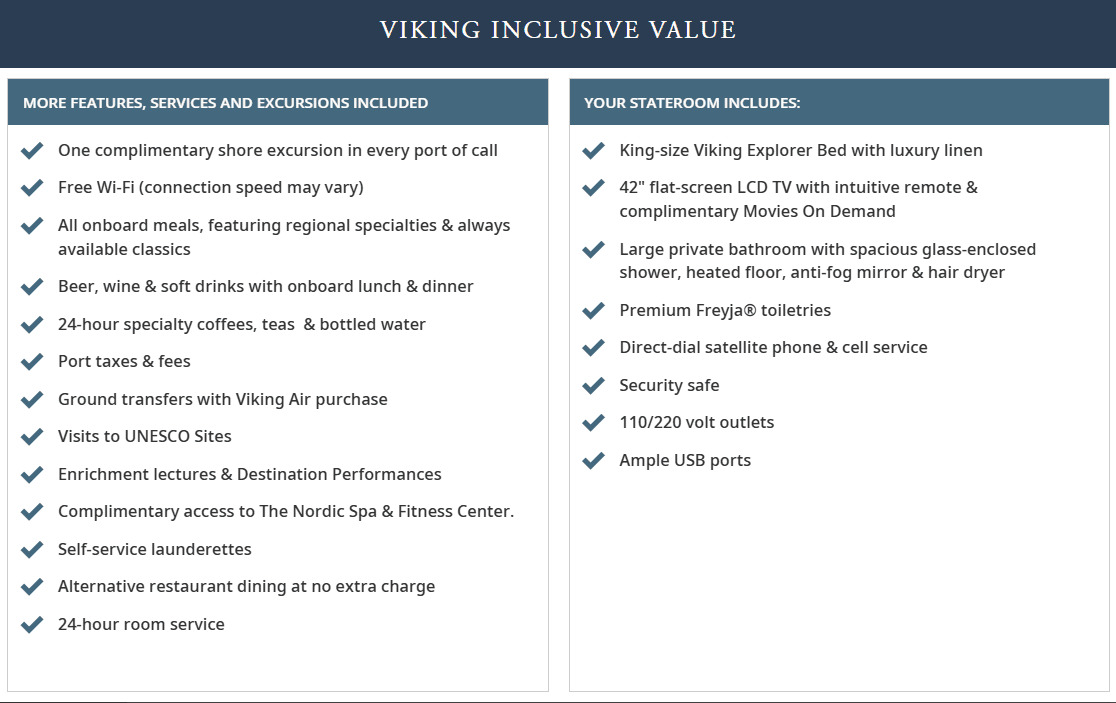
*13 Guided Tours: One shore excursion included per port; all others available at an extra charge.